The ImageGen Wars: From Prompt to Pixel — and Now to Courtroom
In 2022, generating a photorealistic image from a text prompt felt like watching magic happen slowly. In 2026, it takes four seconds and eleven words. The technology has outrun nearly everything around it: the law, the licensing frameworks, the business models, and the artists whose work quietly funded the whole revolution. The battlefield is global, the stakes are enormous, and the fight over who actually owns the output has only just begun.
The Western Contenders
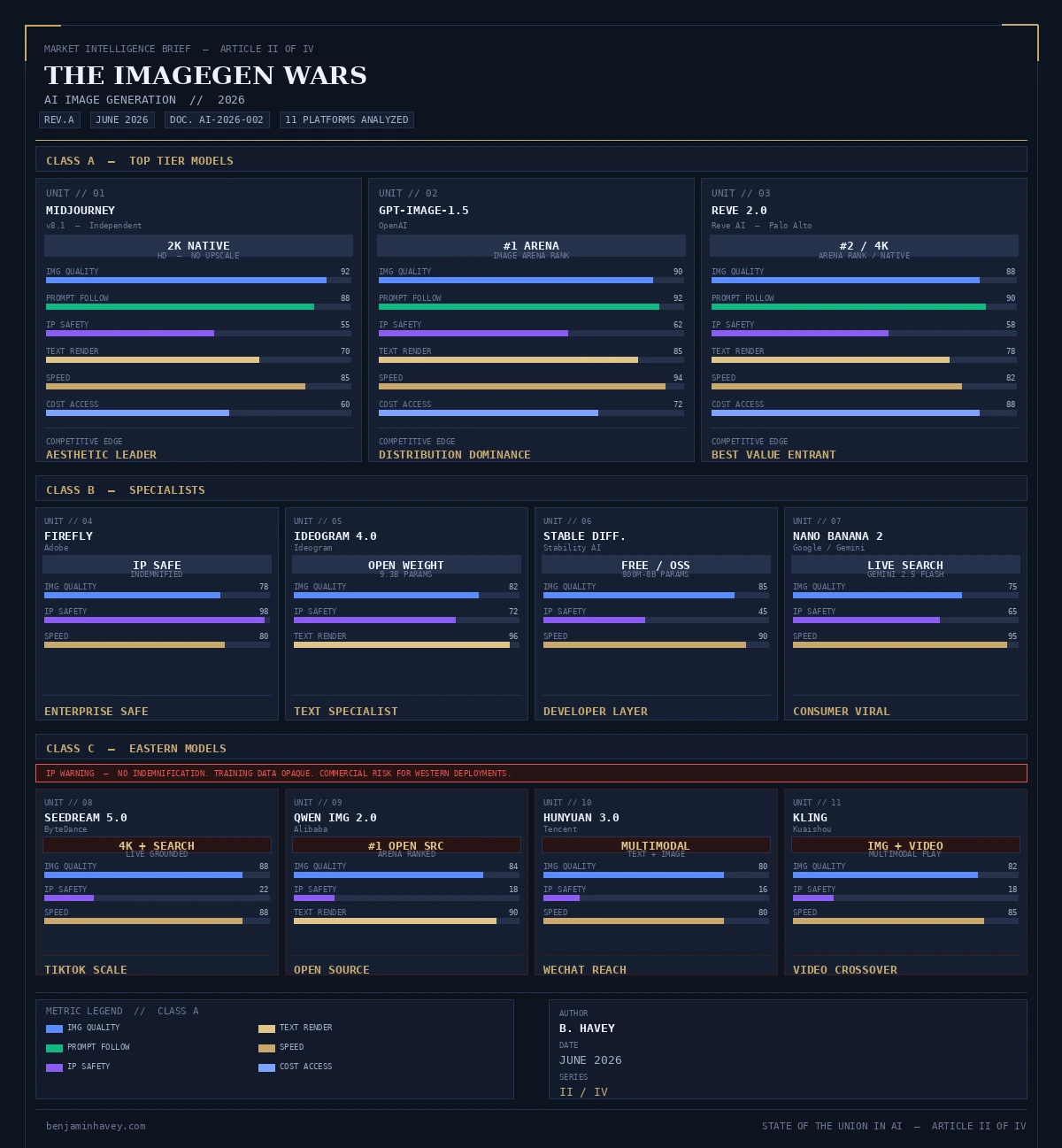
Midjourney v8.1 remains the aesthetic standard-bearer of the industry. Released in late April and made the default model on June 10th, it renders standard jobs four to five times faster than earlier versions, generates native 2K HD images without upscaling, and has meaningfully improved prompt adherence. Still Discord-native, still fiercely independent, and still the model that professional creatives reach for when beautiful output matters more than workflow integration. Midjourney has never taken outside investment and has never needed to. That tells you something about the margins in this business.
GPT-Image-1.5 sits at the top of the Image Arena leaderboard and is the model most people encounter without knowing it — baked into ChatGPT and accessible to hundreds of millions of users who didn’t specifically come looking for an image generator. It replaced DALL-E 3 as OpenAI’s flagship, offering 4x faster generation and significantly improved editing. The distribution advantage here is almost unfair. When your image generator is the default feature of the world’s largest AI interface, you don’t need to win on quality alone.
Stable Diffusion occupies a different category entirely. Where the commercial players compete on output quality and ease of use, it competes on something more durable: freedom. The SD3 architecture, available in model sizes from 800M to 8B parameters, is effectively free at any scale if you own capable hardware. It powers more B2B integrations, custom fine-tunes, and enterprise deployments than any other model in the world — most of which you’ll never see credited. Stable Diffusion is the infrastructure of the ImageGen economy.
Adobe Firefly is the enterprise industry’s comfort blanket, and it has earned that position. Trained exclusively on Adobe Stock, public domain content, and openly licensed material, it’s the only major model that can definitively answer the question every legal department asks: where did this come from? Adobe backs its outputs with IP indemnification for enterprise subscribers, a guarantee no other Western model offers unconditionally. The recent addition of third-party models including OpenAI, Google Imagen 3, Runway, and Flux as selectable options within the Firefly interface is a smart pivot. Adobe is positioning itself as the safe harbor through which enterprises can access the full ecosystem, on their terms.
Nano Banana 2, Google’s Gemini 2.5 Flash-powered image tool, is the consumer wildcard. The viral original found a large audience quickly; the updated version adds real-time information grounding, meaning it can pull current events into image generation in a way that static models can’t. The face and body consistency features are genuinely compelling for social content creators. It’s not the most powerful model in the lineup, but it may be the most used.
Reve 2.0, released June 3rd, is the most interesting new entrant. Built by a Palo Alto startup founded by researchers from Google Brain and NVIDIA, it debuted at number two on the Image Arena leaderboard while being trained on a fraction of the compute of its larger competitors. The headline feature is a “Layout-First” architecture that inverts the conventional approach: rather than generating pixels directly from text, Reve 2.0 drafts a structural blueprint first, then renders. The results, particularly for complex compositions and precise layouts, are striking. At $7.99/month for the Lite tier, it’s also the best value in the space right now.
Ideogram 4.0, also released June 3rd, made a different kind of statement by going open-weight. The 9.3B parameter model is the first major commercial image model to release its weights publicly, with best-in-class text rendering inside images, bounding-box layout control, and native transparency support. For anyone building products on top of image generation, it’s now the most serious open-source option in the field.
The Eastern Front
The Western narrative of the ImageGen Wars is only half the story. The other half is being written in Beijing, Shenzhen, and Hangzhou, and it’s moving just as fast.
Seedream 5.0, released by ByteDance in February, generates images at up to 4K resolution and notably integrates web search, allowing it to create images grounded in current events in a way most models can’t. ByteDance’s distribution via TikTok and Douyin gives Seedream access to a creative audience that dwarfs most Western competitors.
Qwen Image 2.0 from Alibaba, also February, ranks as the strongest open-weight image model by AI Arena evaluations, with particularly impressive performance on Chinese text rendering, a historically hard problem in image generation. It’s free to use and carries full commercial usage rights.
HunyuanImage 3.0 from Tencent and Kling from Kuaishou round out the Chinese tier, with Kling better known for video but maintaining a credible image generation offering as part of its broader multimodal platform.
The quality of these models is not seriously disputed. The training data is a different story. None of the Chinese models offer IP indemnification, and training data practices are opaque by Western standards. The legal frameworks governing copyright in China diverge substantially from the US and EU. For creative professionals working on commercial projects — particularly in entertainment, advertising, and publishing — this creates real exposure. The images may be stunning, but whether you can safely use them in a client deliverable, a campaign, or a film production depends on legal counsel most people haven’t retained yet.
This is Part 2 of a 4-part series on the State of the Union in AI. Part 1 covers the LLM market. Part 3 is coming soon.